Oligonucleotide Manufacturing at Scale: Why Integration, Automation, and System Design Matter
The commercial trajectory of oligonucleotide therapeutics is changing the manufacturing conversation. As more programs advance through clinical development and move toward commercialization, the central question is no longer whether oligonucleotides can be produced at scale. The more pressing issue is how to scale production without compromising product quality, process control, operator safety, or manufacturing efficiency. That challenge is becoming more significant as timelines shorten and expectations around compliance, connectivity, and digital readiness continue to rise.
At laboratory scale, much of the chemistry is well understood. At commercial scale, however, the surrounding process becomes substantially more difficult to manage. Oligonucleotide manufacturing involves a series of tightly linked upstream and downstream operations, including solid-phase synthesis, cleavage and deprotection, purification, desalting and concentration, and, where required, lyophilization. Each of these steps introduces variables that can affect yield, impurity profiles, process robustness, and ultimately the economics of production.
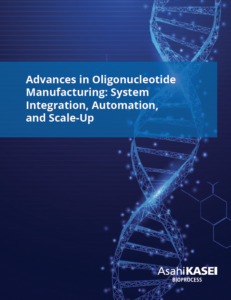
That is the focus of Asahi Kasei Bioprocess’s eBook, Advances in Oligonucleotide Manufacturing: System Integration, Automation, and Scale-Up. Rather than treating synthesis, downstream processing, equipment design, and automation as separate concerns, the eBook considers how they intersect as manufacturers move toward larger and more complex production environments.
Scale-up is not a linear exercise
One of the most important lessons in oligonucleotide manufacturing is that scale-up cannot be approached as a simple mathematical enlargement of a benchtop process. Changes in column diameter, bed height, recirculation volume, flow distribution, and system configuration can all influence process performance. Even when moving between different scales of equipment from the same manufacturer, the physical characteristics of the systems do not necessarily scale proportionally.
The synthesis column is a good example. At larger scale, the column must maintain uniform distribution of phosphoramidites and reagents across the solid support while accommodating changes in resin volume during processing. Polymeric supports can swell and shrink as solvents change, while larger column diameters introduce additional challenges in flow distribution and pressure control. Oversizing a column may appear attractive from a throughput perspective, but increased hold-up volume and backpressure can work against both yield and efficiency.
The same principle applies to process transfer. An example presented in the eBook shows that increasing nominal synthesis scale from 100 µmol to 300 µmol does not automatically point to a single optimal column configuration. Different combinations of column diameter and bed height may satisfy the volume requirement, but the best choice depends on how sensitive the process is to those changes. In some cases, maintaining bed height may justify adjusting the nominal scale rather than forcing the process into a predetermined target. Simulation and process-development tools can therefore play an important role before material ever reaches the production system.
Downstream processing must scale with equal care
Scale-up challenges do not end when synthesis is complete. Purification introduces its own mechanical and process constraints, particularly as manufacturers move toward larger-diameter chromatography columns and higher material loads. Reversed-phase HPLC and ion-exchange chromatography have established roles in commercial oligonucleotide manufacturing, but maintaining resolution and recovery at scale depends heavily on column design, packing quality, pressure management, and consistent gradient delivery.
Dynamic axial compression can help address some of these challenges by creating a more uniform packed bed and reducing the likelihood of channels or gaps that compromise separation. The relationship between injection loop volume and column volume also becomes important during scale-up because changes in that ratio can contribute to peak distortion and reduced separation efficiency. Following purification, tangential flow filtration introduces additional parameters, including membrane type, pore size, membrane loading, crossflow rate, and transmembrane pressure, all of which must be optimized to support effective desalting and concentration.
Taken together, these considerations reinforce a broader point: successful scale-up depends on maintaining relationships between process parameters rather than simply increasing equipment size. The more tightly integrated those decisions are across the manufacturing train, the more effectively manufacturers can preserve process performance as production grows.
Automation is becoming part of the process architecture
The increasing complexity of oligonucleotide manufacturing also changes the role of automation. In this setting, automation is not simply a way to replace manual tasks. It becomes a means of managing process complexity, improving repeatability, supporting data integrity, and creating a more consistent path from development to GMP manufacturing.
Recipe management illustrates the problem particularly well. A chromatography method may contain a relatively small number of steps, while an oligonucleotide synthesis recipe can contain hundreds or even thousands. Attempting to manage that level of complexity with software originally designed for other unit operations can make process development unnecessarily cumbersome. Purpose-built software can instead allow users to build, modify, reuse, and validate recipe sections in a way that more closely reflects how synthesis is actually performed.
Asahi Kasei Bioprocess’s OCELOT™ System Control platform is presented in the eBook as one example of this approach. The system supports recipe and method configuration, simulation, context-based editing, and automated adjustment of parameters based on process-specific critical process parameters. Its architecture is also designed to connect with plant-wide systems, including historians and distributed control systems, while supporting requirements associated with regulated manufacturing.
Simulation can also shorten the distance between process development, training, and execution. Operators can practice running recipes, observe valve and pump behavior, review batch progression, and test changes without moving process fluids. Virtual systems can be made available before physical equipment is installed, allowing teams to train earlier and enter startup with greater familiarity with the control environment.
Integration can eliminate process steps, not just automate them
Another opportunity lies in reconsidering where one unit operation ends and another begins. In many manufacturing environments, cleavage and deprotection are performed separately from ultrafiltration and diafiltration, requiring intermediate product handling and movement between pieces of equipment or process areas. Every transfer adds time and creates another point at which variability, product loss, contamination, or operator exposure may be introduced.
The THESYS® C&D/TFF system described in the eBook integrates cleavage and deprotection with ultrafiltration/diafiltration in a single automated platform. The design reduces transfers between systems, consolidates asset management, and simplifies some of the IT and maintenance requirements associated with operating two separate pieces of equipment. It also incorporates process features such as temperature control for exothermic reagent addition, inline quenching, and geometry intended to improve final product recovery.
The integrated system also addresses manufacturing footprint. A dual-use tank incorporated into the skid eliminates the need for a separate external tank in configurations where that is appropriate, while the software and piping architecture can still accommodate an external tank when the process requires one. The significance is not simply that two operations have been placed on one skid, but that the process has been redesigned to remove unnecessary stabilization, transport, and handling steps.
Equipment design has a direct effect on manufacturing performance
Commercial-scale equipment must also be evaluated from the operator’s perspective. Large stainless-steel synthesis columns can be heavy, difficult to maneuver, and labor-intensive to disassemble and clean. Traditional configurations may require multiple operators for changeover activities, increasing both the physical demands of the work and opportunities for exposure to solvents and process media.
The THESYS® ACS Ergo synthesis column approaches those issues through mechanical design. A split-column configuration, self-locking rotation mechanism, and I-bar assembly system are intended to simplify disassembly, media removal, cleaning, and reassembly. According to the eBook, a changeover process that previously required multiple operators and several hours can be completed by one operator in approximately 30 to 45 minutes.
That kind of improvement illustrates why ergonomics should not be considered separately from process efficiency. Equipment that is easier to operate and maintain can reduce downtime, simplify routine interventions, and lower the personnel burden associated with larger-scale production. As manufacturers confront an industry-wide shortage of experienced oligonucleotide personnel, equipment and software that reduce unnecessary operational complexity may become increasingly valuable.
Building for what comes next
The next stage of oligonucleotide manufacturing is likely to be shaped as much by system architecture and data strategy as by chemistry. Digitalization, simulation, structured process data, and plant-wide connectivity are creating opportunities to improve technology transfer, batch review, training, and process consistency. Longer term, those same capabilities may provide the foundation for greater use of analytics, artificial intelligence, and digital twins.
The manufacturing platforms being developed today must therefore solve two problems at once. They must support the demands of current solid-phase oligonucleotide processes while remaining flexible enough to accommodate new software tools, alternative synthesis approaches, and evolving production models. The eBook argues for an approach built around that flexibility—one in which equipment, automation, data, and operator needs are considered as elements of the same manufacturing strategy.
For manufacturers preparing to scale an oligonucleotide process, the implications are significant. Equipment selection, process development, automation, facility planning, and downstream integration cannot be treated as independent decisions. Each affects the others, and decisions made early in development can have lasting consequences for manufacturing efficiency and scalability.
Advances in Oligonucleotide Manufacturing: System Integration, Automation, and Scale-Up explores these issues in greater technical depth, with practical discussions of synthesis and purification scale-up, process integration, automation, equipment design, operator ergonomics, and emerging digital capabilities.